Overview
At a glance
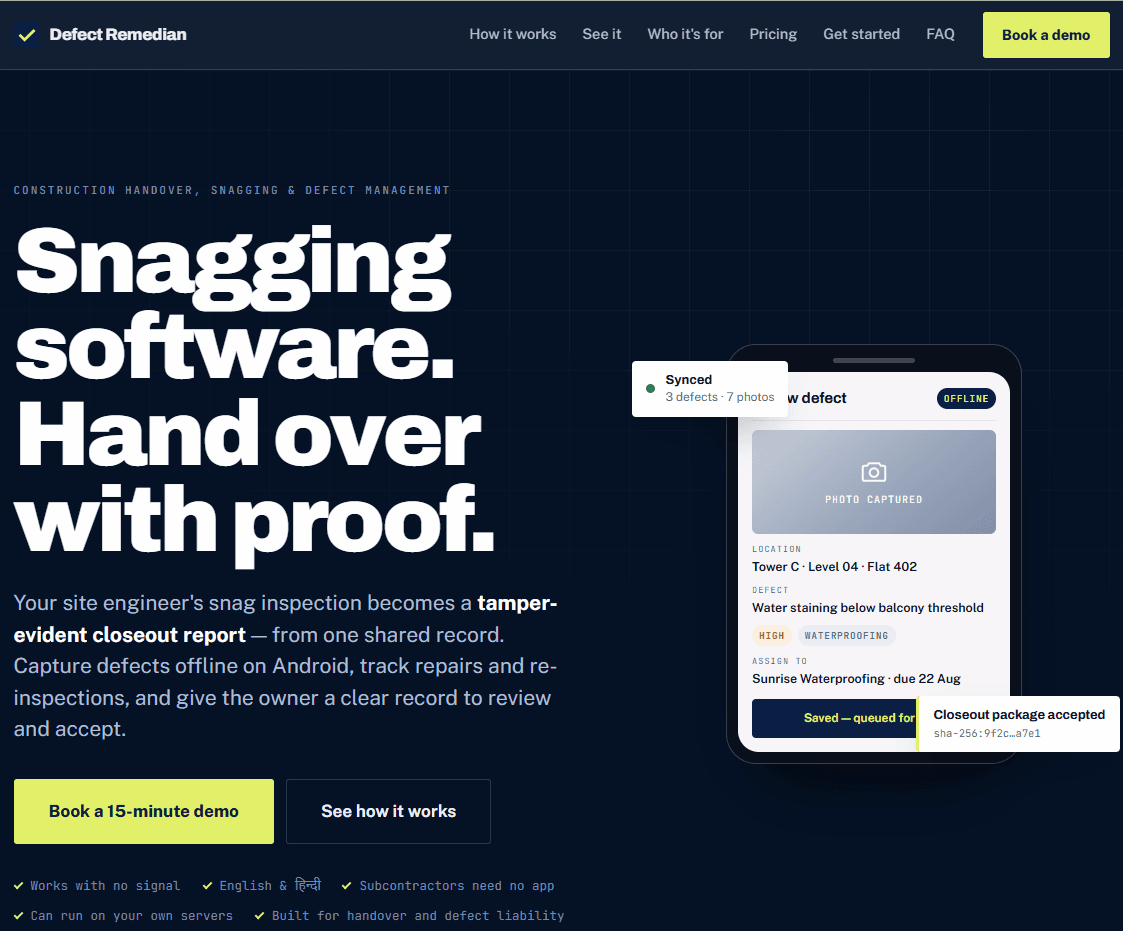
Defect Remedian is snagging and defect management software for construction handover in India. A site engineer's inspection becomes a tamper-evident closeout report from one shared record: defects are captured offline on Android, repairs and re-inspections are tracked, and the owner reviews and accepts the result.
Screenshots
The live product
Captured from the live site on desktop and mobile. The capture date is under each image.

Problem
The challenge
The public Defect Remedian site describes the capture, repair, re-inspection, and closeout workflow, the teams it serves, and its pricing model. This study describes what that site shows; it does not include customer data or private metrics.
When the snag list is split across chats, spreadsheets, and paper, nobody is sure who owns a defect, items get closed without being re-checked, and years later nobody can prove what was fixed. Handover slips and payments wait.
Solution
How the product solves it
Every defect gets an owner, a deadline, and a full history. The closeout report is assembled from that record with dated, attributed before-and-after photos, and the accepted package is frozen so that any change breaks its SHA-256 digest.
- Offline capture on Android
- Defect register
- Floor-plan pins
- Subcontractor repair links
- Independent re-inspection
- Closeout package with SHA-256 digest
- Owner acceptance and exceptions
- Excel import
- PDF and Word export
- English and Hindi
- Read-only access for owners' representatives
Proof
What you can verify
- A public product site describing offline capture, subcontractor repair links, re-inspection, and closeout packages.
- A public pricing model (per active project, billed annually) and a demo booking flow.
- A free snag-list template and guides for construction handover.
System view
Workflow and public architecture
These diagrams reflect the routes and interactions verified on the public product. They do not infer private infrastructure.
From snag to closeout
- 1Capture the defect on site, photo first, on an Android phone; it queues offline and syncs when there is signal.
- 2Assign it to a subcontractor, who gets a WhatsApp link to that one defect and uploads the fix.
- 3Someone who did not do the work re-checks it and passes or fails it.
- 4The closeout report is built from the record, and the owner reviews and accepts it online.
Verified public architecture
- Android capture app with an offline queue
- Sync to a shared defect register
- Single-defect repair links
- Re-inspection and approval
- Closeout package and owner acceptance
Technical detail
How it is built
Users and roles
Site engineers capture, subcontractors fix through a link, an independent checker re-inspects, and the owner's side reviews and accepts. Read-only access lets committees and owners' representatives see the reports without changing anything.
- Site engineer
- Captures defects with photos on an Android phone, even with no signal.
- Subcontractor
- Gets a WhatsApp link to a single defect and uploads the fix with a one-time code, without an account or an app.
- Checker
- Someone who did not do the work passes or fails the fix.
- Owner's representative
- Reviews the closeout report and records acceptance or exceptions; read-only access shows the reports and nothing else.
Main user journeys
The public site describes a three-step flow: capture on site, fix and re-check, and hand over the proof.
From snag to closeout
- Capture the defect on site, photo first, on an Android phone; it queues offline and syncs when there is signal.
- Assign it to a subcontractor, who gets a WhatsApp link to that one defect and uploads the fix.
- Someone who did not do the work re-checks it and passes or fails it.
- The closeout report is built from the record, and the owner reviews and accepts it online.
Set up a project
- Import towers, floors, and units from existing Excel sheets.
- Invite the site team, the handover team, and the client's representative.
- Start with the project closest to handover.
- Add more projects as the team grows.
Architecture
As described on the public site: an Android capture app queues defects and photos offline and syncs them to a shared register; subcontractors work from single-defect links protected by a one-time code; re-inspection results and owner acceptance are recorded against the same defect history. The product can also run on a customer's own servers. Private infrastructure details are not asserted.
Technology stack
- Described on the public site
- Android app with an offline queue, Web defect register, SHA-256 package digest, English and Hindi interface
- Deployment options
- Hosted service, Customer's own servers under an annual licence
Implementation details
- Frontend
- Android capture app
- Web defect register
- English and Hindi interface
- Authentication
- One-time codes on subcontractor repair links
- Authorization
- Repair links can never close a defect
- Read-only access for owners' representatives
- Integrations
- Excel import for towers, floors, and units
- WhatsApp links for subcontractors
- Deployment
- Hosted service at defectremedian.com
- Own-server option under an annual licence
Key technical decisions
- Make capture work offline first, with retries that do not create duplicates.
- Let subcontractors fix through a link instead of an account.
- Keep the person who fixes separate from the person who verifies.
- Freeze the accepted package and make it verifiable by SHA-256.
Security and reliability
- Accepted closeout packages are frozen; changing a single byte changes the SHA-256 digest.
- Subcontractor links use a one-time code and can never close a defect.
- Offline captures stay queued on the phone until sync succeeds.
- An own-server deployment is available for stricter data policies.
Lessons learned
- Site software has to work where the work happens: basements with no signal, and teams that prefer Hindi.
- Pricing per project, not per login, keeps every party in the same register.
- Proof matters as much as tracking: an accepted report has to be checkable years later.